


- Industry News2025-09-16
- Air Floating Platform: Analysis of the Core Supporting Technology for Mass Production Perovskite Coating Process


The air flotation platform plays a crucial role in the mass-produced perovskite coating process. Its unique non-contact suspension technology not only improves coating uniformity and stability but also significantly enhances production efficiency and product quality.
This article will provide a detailed introduction to the key role of air-flotation platforms in perovskite coating processes and their practical application cases, as well as discuss current challenges and future optimization directions.
Core advantages of the air-flotation platform
1. High-precision positioning and smooth transmission
Perovskite coating processes require extremely high flatness and motion stability of substrates (such as glass and flexible substrates). The air-floating platform uses air bearings to achieve non-contact levitation, eliminating mechanical friction and preventing vibration or offset, ensuring stable positional accuracy (usually down to the micron level) during high-speed transport, thereby improving coating uniformity.
2. Avoid contamination and damage
Traditional mechanical rails may generate particles or scratches due to friction, but the contactless nature of the flotation platform reduces contamination risks, which is especially critical for perovskite films (sensitive to surface defects), preventing impurities that could degrade device performance (such as loss of photovoltaic efficiency).
3. Meets the demand for large-scale mass production
Mass-produced perovskite coating requires continuous, high-speed processing of large-sized substrates (such as over 1 meter). The air-floating platform supports large-stroke, high-acceleration movement, paired with precision control systems (such as laser interferometer positioning), meeting the demands of large-scale production processes.
4. Improved process consistency
Perovskite coating (such as slit coating and scraping) requires strict synchronization between substrate speed and coating head. The dynamic response of the air flotation platform is fast and velocity stability is high (within ±0.1%), ensuring uniform solution spreading, reducing thickness fluctuations (CV value <3%), and improving device yield.
5. Compatible with complex process environments
The air-flotation platform can be integrated into glove boxes or dry environments, avoiding lubrication issues in traditional mechanical systems under inert atmospheres (such as N₂), suitable for perovskite's water-oxygen sensitivity characteristics.
Practical application cases
Slot Die
Challenges and Optimization Directions
1. Cost
The initial investment for air flotation systems is relatively high, requiring mass production scale to spread out costs. As the technology matures and market demand increases, the cost of air flotation platforms is expected to gradually decrease.
2. Airflow control
Airflow uniformity is crucial for the performance of the flotation platform. Further optimization of airflow control technology is needed to ensure the stability and uniformity of the air film and avoid local suspension instability.
3. Maintenance of air bearings
Although air bearings have long lifespans and low maintenance, they still require regular inspection and maintenance to ensure stable and reliable performance. Especially in environments with high humidity or high pollution, special attention must be paid to air filtration and cleaning of air sources.
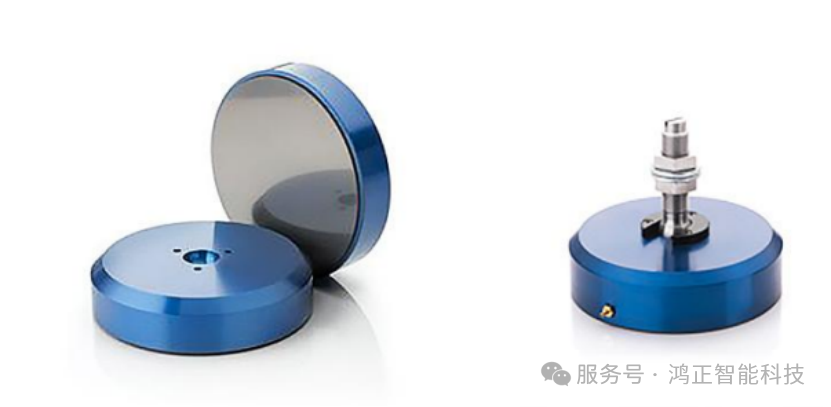
(Planar air bearing)
Design principles of air-floating platforms
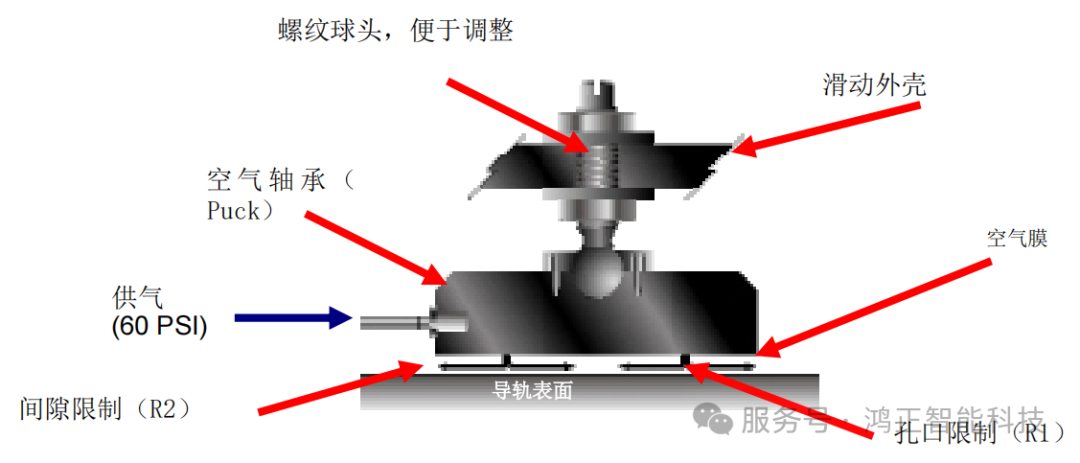
The design principle of the air-floating platform is to use air bearings that squeeze air outward through micro-holes, creating an airflow that lifts the gantry and produces a non-contact air guide rail. Below are the key parameters and working principles of air bearings:
1. Introduction to air bearings
Air bearings are non-contact bearings that use high-pressure gas (usually air) to form a film of air between the bearing and the shaft, enabling frictionless or extremely low-friction movement. Compared to traditional rolling bearings or oil film bearings, air bearings offer advantages such as no wear, high precision, low vibration, low heat generation, and long service life.
- Zero friction: No mechanical contact, long service life.
- High precision: suitable for nanoscale motion control.
- Low vibration & low noise: suitable for precision instruments.
- High temperature and corrosion resistance: suitable for special environments (such as vacuum and cleanrooms).
2. Working principle
High-pressure gas (such as compressed air) is continuously supplied through an external air pump, forming a stable air film between the bearing and the shaft. Gas enters the bearing clearance through micropores or throttles, forming a uniform pressure distribution.
3. Key parameters affect membrane performance
- Gas pressure: The higher the pressure, the greater the film rigidity (hydrostatic bearings need to stabilize air pressure, while dynamic bearings depend on rotational speed).
- Gap size: The smaller the gap (usually micron-level), the higher the rigidity, but it demands extremely high machining precision.
- Surface roughness: requires ultra-precise polishing (Ra<0.1 μm; otherwise, gas leakage can cause unstable air films.
- Gas type: Compressed air is the most commonly used, requiring water and dust removal (otherwise, stability is affected).
4. Why can air membranes support heavy objects?
- Bernoulli effect: The pressure of high-speed airflow drops in a narrow gap, creating a pressure difference (dynamic bearing).
- External pressurization: Hydrostatic bearings directly resist external force through high-pressure gas (similar to the principle of air-cushioned boats).
- Source of stiffness: The compressibility of the gas film gives the system elasticity, but with precise control, extremely high rigidity can be achieved (for example, semiconductor equipment maintaining nanometer-level precision even when carrying hundreds of kilograms).
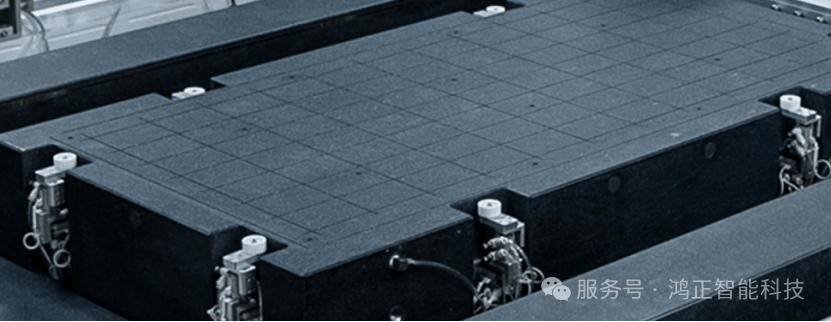
000-level marble platform
Grinding Precision:
Running runout: ±2μm;
Summary
The flotation platform plays an irreplaceable and important role in mass-produced perovskite coating processes. Its advantages include high-precision positioning, smooth transmission, prevention of contamination and damage, adaptability to large-area mass production, improved process consistency, and compatibility with complex process environments, making it one of the core equipment for perovskite coating processes, especially in GW-level production lines, where it has become an industry benchmark choice.
Despite challenges such as cost and airflow control, with continuous technological optimization and increasing market demand, the air-floating platform will play a greater role in the perovskite coating field, supporting the large-scale development of perovskite photovoltaic technology.
Hot News
-
2026-08-21
- Carbon Nanotubes: The "Black Gold" Inside the Coating Machine Head, The "Super Material" In the Coating Process
- Simply put, carbon nanotubes can be seen as seamless, hollow tubular structures formed by rolling single or multiple layers of graphene (i.e., single-atom thickness layers of carbon atoms). Their diameters are at the nanoscale, and their lengths can reach microns or even millimeters, with an extremely high aspect ratio.
-
2026-08-13
- Air-Floating Shock Absorbing: The "Invisible Guardian" Behind Coating Precision
- On high-precision coating production lines, there is a dilemma that almost every process engineer has experienced: while the coating head, feeding system, and temperature and humidity control parameters all meet standards, the film surface repeatedly shows horizontal lines
-
2026-05-20
- Building a Global Energy Internet: Enabling Clean Energy to Cross Mountains and Seas for Global Sharing
- Currently, the global energy landscape is undergoing profound adjustments. Fossil fuels still account for more than 80% of primary energy consumption, with challenges such as tightening resource constraints, intensifying climate warming, and insufficient access to electricity in some regions.
-
2026-05-14
- Light Chasing Chronicle: A "Sunlight Relay Race" Across Half the Earth
- Have you ever wondered: the sun never works overtime, but humans need electricity 24 hours a day?