


- Industry News2025-02-07
- 23.4%! Westlake University Wang Rui Team Achieves Major Breakthrough in Perovskite/CIGS Tandem Solar Cells


Wang Rui's team from the Future Industry Research Center and College of Engineering at Westlake University has made significant breakthroughs in the field of flexible tandem solar cells, successfully stacking perovskite with copper indium gallium selenide materials, resulting in a photoelectric conversion efficiency of 23.4%. The related research paper was recently published in Nature Photonics.

Flexible perovskite/copper indium gallium selenide tandem solar cells.
If single-junction perovskite solar cells are like a "single-layer cake," then tandem solar cells come in multi-layered flavors. Different flavors of cake layers correspond to different semiconductor material layers, each capable of "catching" sunlight of a specific wavelength. In this way, it can absorb a wider range of solar energy than "single-layer" cells, converting sunlight into electricity more efficiently, thus breaking the ceiling for single-junction solar cell conversion efficiency.
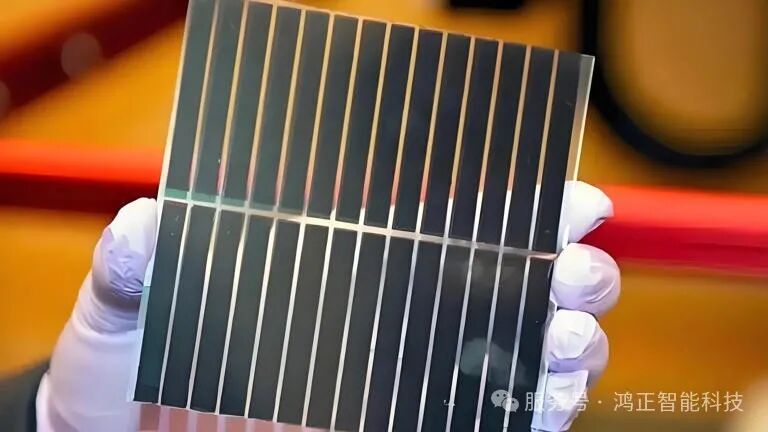
The team successfully layered perovskite with copper, indium, gallium, and selenide—two different flavors of the "cake". This flexible, thin, and lightweight multilayer solar cell is only as thick as a hair's diameter and is expected to be applied in the future to irregular surfaces such as buildings, automobiles, aircraft, and flexible wearable devices.

Hot News
-
2026-08-21
- Carbon Nanotubes: The "Black Gold" Inside the Coating Machine Head, The "Super Material" In the Coating Process
- Simply put, carbon nanotubes can be seen as seamless, hollow tubular structures formed by rolling single or multiple layers of graphene (i.e., single-atom thickness layers of carbon atoms). Their diameters are at the nanoscale, and their lengths can reach microns or even millimeters, with an extremely high aspect ratio.
-
2026-08-13
- Air-Floating Shock Absorbing: The "Invisible Guardian" Behind Coating Precision
- On high-precision coating production lines, there is a dilemma that almost every process engineer has experienced: while the coating head, feeding system, and temperature and humidity control parameters all meet standards, the film surface repeatedly shows horizontal lines
-
2026-05-20
- Building a Global Energy Internet: Enabling Clean Energy to Cross Mountains and Seas for Global Sharing
- Currently, the global energy landscape is undergoing profound adjustments. Fossil fuels still account for more than 80% of primary energy consumption, with challenges such as tightening resource constraints, intensifying climate warming, and insufficient access to electricity in some regions.
-
2026-05-14
- Light Chasing Chronicle: A "Sunlight Relay Race" Across Half the Earth
- Have you ever wondered: the sun never works overtime, but humans need electricity 24 hours a day?